





















Generator Gas Line Sizing Chart: Complete 2026 Reference


Generator Gas Line Sizing Chart: Complete 2026 Reference
🕑 14 min read Updated: June 2026 Table of Contents The Fast Answer: Generator Gas Line Sizing Chart Natural Gas Line Sizing Chart for Common Generac Models Propane...
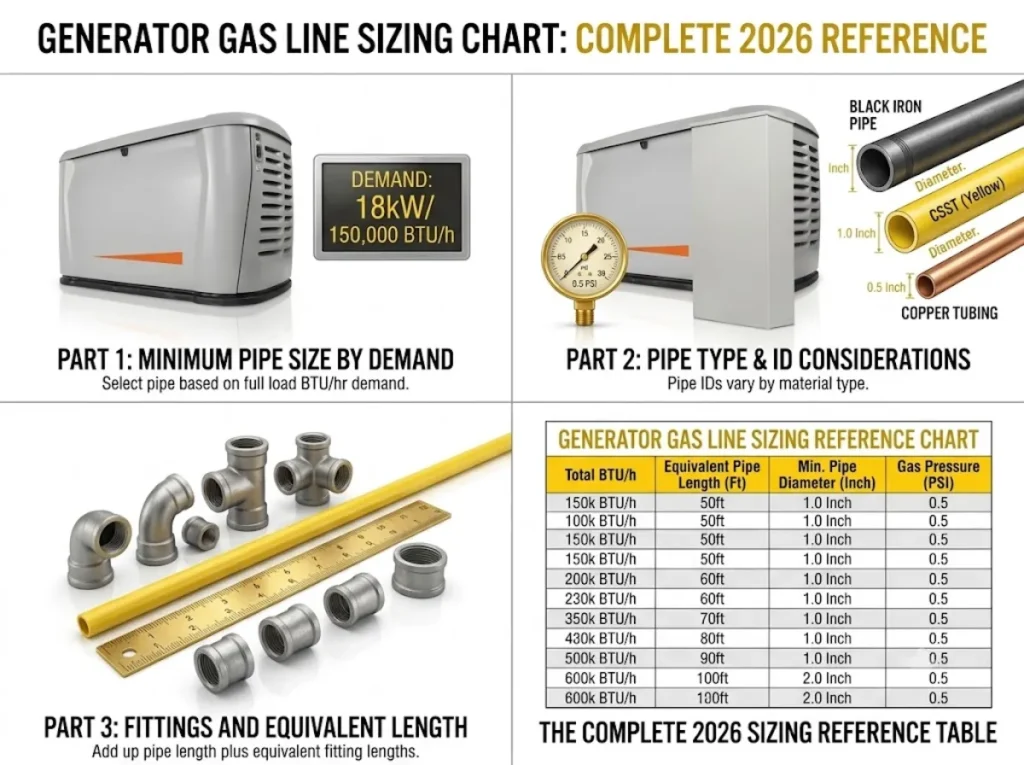
- Generator gas line sizing chart requirements depend on the generator’s fuel flow rating (CFH), the fuel type (natural gas or propane), and the total equivalent length of the run including fittings.
- Common Generac fuel flow ratings at full load: 14kW needs 178 CFH natural gas, 18kW needs 220 CFH, 22kW needs 289 CFH, 24kW needs 315 CFH, and 26kW needs 340 CFH.
- Natural gas line sizing typically requires 3/4 inch pipe for short 14kW runs, 1 inch pipe for standard 18kW and 22kW installations, and 1-1/4 inch pipe for 24kW and 26kW runs beyond 25 feet.
- Propane gas line sizing is meaningfully smaller than natural gas at the same generator kW rating because propane delivers approximately 2.5 times the BTU content per cubic foot at typical residential pressures.
- Equivalent length calculation adds 2-3 feet per 90-degree elbow, 3-5 feet per tee, and 5-10 feet per regulator to the physical pipe run when determining the correct pipe diameter.
- Undersized gas lines cause pressure drops during full-load operation that trigger generator error codes, reduce output, and can lead to premature engine wear from lean fuel-air mixtures.
The correct generator gas line sizing chart approach starts with the generator’s fuel flow rating in cubic feet per hour (CFH), matches it against the total equivalent length of the pipe run, and selects the smallest pipe diameter that maintains acceptable pressure drop under full load. Common Generac Guardian Series air-cooled generators require 178 to 340 CFH of natural gas at full load depending on model, and the corresponding pipe size ranges from 3/4 inch to 1-1/4 inch for typical residential runs. This article delivers the sizing charts, calculation methodology, and equivalent length adjustments needed to size gas lines correctly for any Generac install.
Across hundreds of Generac home standby generator orders shipped nationwide, IB Lighting’s electrician-led team walks buyers and installers through the generator gas line sizing chart before every install to confirm the planned pipe size will support the generator at full load. Founded in 2013 by a licensed Master Electrician with field experience across DTE Energy and Consumers Energy projects in Michigan, IB Lighting resells the unit but does not perform installation directly. We help buyers and their installers verify sizing against reference standards. This article is that walkthrough, using methodology aligned with NFPA 54 National Fuel Gas Code sizing tables and installation specifications verified against official Generac installation documentation.
The Fast Answer: Generator Gas Line Sizing Chart
The right pipe size for your generator depends on three honest factors: the generator’s fuel flow rating in CFH at full load, the total equivalent length of the pipe run including fittings, and the fuel type (natural gas or propane). The table below shows the typical natural gas pipe size recommendations for common Generac models across three run-length ranges.

| Generac Model | Short Run (under 25 ft) | Medium Run (25-75 ft) | Long Run (75-150 ft) |
|---|---|---|---|
| 14kW 7258 (178 CFH) | 3/4 inch pipe | 1 inch pipe | 1 inch pipe |
| 18kW 7259 (220 CFH) | 1 inch pipe | 1 inch pipe | 1-1/4 inch pipe |
| 22kW 7260 (289 CFH) | 1 inch pipe | 1-1/4 inch pipe | 1-1/4 inch pipe |
| 24kW 7261 (315 CFH) | 1 inch pipe | 1-1/4 inch pipe | 1-1/2 inch pipe |
| 26kW (340 CFH) | 1-1/4 inch pipe | 1-1/4 inch pipe | 1-1/2 inch pipe |
The honest reading: most residential Generac installations use 1 inch schedule 40 black iron pipe for 14kW through 22kW models on standard 25-75 foot runs, and 1-1/4 inch pipe for 24kW and larger models. Short runs under 25 feet may allow pipe size reductions for the 14kW and 18kW. Long runs beyond 75 feet or complex routing with multiple fittings typically require going up one pipe size to maintain acceptable pressure drop. Always verify the final sizing decision against NFPA 54 tables and consult with your licensed installer.
Pro tip: The most common gas line sizing mistake is calculating pipe size using only the physical straight-line distance without accounting for fittings. Every 90-degree elbow adds 2-3 feet of equivalent length. Every tee adds 3-5 feet. The gas regulator itself adds 5-10 feet. On a physical 50-foot run with four elbows, two tees, and one regulator, the actual equivalent length is closer to 75-85 feet, which can push the correct pipe size up one full diameter. Always calculate equivalent length before selecting pipe size.
Natural Gas Line Sizing Chart for Common Generac Models
The natural generator gas line sizing chart below applies to schedule 40 black iron pipe with typical residential natural gas supply pressure (7 to 14 inches water column) and standard 0.5 inch water column maximum pressure drop. This is the reference standard used by NFPA 54 and adopted by most residential building codes across the United States.
Natural gas sizing chart for Generac 14kW (178 CFH)
| Equivalent Length | Recommended Pipe Size |
|---|---|
| Up to 30 feet | 3/4 inch pipe |
| 30 to 80 feet | 1 inch pipe |
| 80 to 200 feet | 1-1/4 inch pipe |
| Over 200 feet | 1-1/2 inch pipe |
Natural gas sizing chart for Generac 18kW (220 CFH)
| Equivalent Length | Recommended Pipe Size |
|---|---|
| Up to 20 feet | 3/4 inch pipe |
| 20 to 60 feet | 1 inch pipe |
| 60 to 150 feet | 1-1/4 inch pipe |
| Over 150 feet | 1-1/2 inch pipe |
Natural gas sizing chart for Generac 22kW (289 CFH)
| Equivalent Length | Recommended Pipe Size |
|---|---|
| Up to 15 feet | 3/4 inch pipe (borderline) |
| 15 to 40 feet | 1 inch pipe |
| 40 to 100 feet | 1-1/4 inch pipe |
| Over 100 feet | 1-1/2 inch pipe |
Natural gas sizing chart for Generac 24kW and 26kW
| Equivalent Length | 24kW (315 CFH) | 26kW (340 CFH) |
|---|---|---|
| Up to 25 feet | 1 inch pipe | 1-1/4 inch pipe |
| 25 to 80 feet | 1-1/4 inch pipe | 1-1/4 inch pipe |
| 80 to 180 feet | 1-1/4 inch pipe | 1-1/2 inch pipe |
| Over 180 feet | 1-1/2 inch pipe | 2 inch pipe |
Propane Gas Line Sizing Chart for Common Generac Models
The propane generator gas line sizing chart below applies to residential propane distribution at typical 11 inch water column supply pressure downstream of the second-stage regulator, with 0.5 inch water column maximum pressure drop. Propane pipe sizing is meaningfully smaller than natural gas at the same generator kW rating because propane delivers 2,516 BTU per cubic foot compared to 1,032 BTU per cubic foot for natural gas.
Propane sizing chart for Generac 14kW and 18kW
| Equivalent Length | 14kW (72 CFH propane) | 18kW (90 CFH propane) |
|---|---|---|
| Up to 30 feet | 1/2 inch pipe | 1/2 inch pipe |
| 30 to 70 feet | 1/2 inch pipe | 3/4 inch pipe |
| 70 to 150 feet | 3/4 inch pipe | 3/4 inch pipe |
| Over 150 feet | 3/4 inch pipe | 1 inch pipe |
Propane sizing chart for Generac 22kW, 24kW, and 26kW
| Equivalent Length | 22kW (116 CFH propane) | 24kW/26kW (130-140 CFH propane) |
|---|---|---|
| Up to 25 feet | 1/2 inch pipe | 3/4 inch pipe |
| 25 to 60 feet | 3/4 inch pipe | 3/4 inch pipe |
| 60 to 150 feet | 3/4 inch pipe | 1 inch pipe |
| Over 150 feet | 1 inch pipe | 1 inch pipe |
Why propane sizing charts show smaller pipes
Propane’s higher BTU density means the generator draws approximately 40 percent of the cubic feet per hour volume required for natural gas at the same kW rating. A 22kW Generac drawing 289 CFH of natural gas draws approximately 116 CFH of propane. This lower flow volume allows correspondingly smaller pipe diameters while maintaining acceptable pressure drop. Verify propane sizing against your specific installer’s local code and NFPA 58 propane installation standards.
Why Correct Gas Line Sizing Matters
Correct gas line sizing chart application is not a minor detail. Undersized gas lines cause specific operational problems that appear months or years after installation and can significantly reduce generator reliability during exactly the outages when reliability matters most.
Pressure drop under full load
Every foot of pipe adds friction that causes pressure to drop between the fuel source and the generator inlet. Undersized pipes amplify this pressure drop, particularly during full-load operation when fuel flow is at its peak. When inlet pressure falls below the generator’s minimum operating specification, the engine cannot maintain rated output. In residential natural gas systems operating at 7 to 14 inches water column, the acceptable pressure drop is 0.5 inches water column maximum end-to-end.
Generator error codes and derating
Modern Generac Guardian Series generators actively monitor fuel pressure at the inlet. When pressure drops below the operational threshold, the controller triggers a “low fuel pressure” error code, derates output, or shuts the generator down entirely. This is a safety feature that prevents lean fuel-air combustion which can damage the engine. Undersized gas lines are one of the most common causes of “warranty” service calls that turn out to be install-related rather than generator defects.
Long-term engine wear from lean combustion
When gas lines are marginally undersized (not so bad that the generator refuses to start, but not delivering full flow at peak demand), the engine runs lean during high-load operation. Lean combustion causes elevated exhaust temperatures, accelerated valve wear, and reduced engine life. This is the failure mode that shows up 3-5 years post-install rather than immediately, and it is entirely preventable with correct initial sizing.
Understanding CFH: The Foundation of Gas Line Sizing
Cubic feet per hour (CFH) is the standard measurement of fuel flow used in all generator gas line sizing charts and calculations. Understanding what CFH means and how it varies by generator model is the foundation of correct sizing.
What CFH represents
CFH represents the volume of gas (measured in cubic feet at standard temperature and pressure) that flows through the gas line per hour. Generators are rated at their maximum CFH consumption at full load. Manufacturers publish CFH ratings for both natural gas and propane, and the two ratings differ significantly because of the BTU density difference between the two fuels.
Generac Guardian Series CFH ratings reference
| Generac Model | Natural Gas CFH (Full Load) | Propane CFH (Full Load) |
|---|---|---|
| 14kW 7258 | 178 | 72 |
| 18kW 7259 | 220 | 90 |
| 22kW 7260 | 289 | 116 |
| 24kW 7261 | 315 | 130 |
| 26kW | 340 | 140 |
Why the natural gas vs propane CFH gap matters
The 40 percent smaller propane CFH rating at each generator size directly translates to smaller pipe diameters for propane runs versus natural gas runs at the same generator kW. This is a real economic advantage for propane installations and a real technical difference that affects sizing decisions. Buyers switching between fuel types during install planning should recalculate pipe sizing entirely rather than assuming the natural gas sizing applies to propane.
Equivalent Length Method: Accounting for Fittings
Equivalent length calculation is the professional method for accounting for pressure loss through fittings, valves, and other in-line components. Physical pipe length alone is insufficient for accurate sizing because fittings create additional pressure drop equivalent to substantial lengths of straight pipe.
Fittings equivalent length reference table
| Fitting Type | Equivalent Length Added |
|---|---|
| 90 degree elbow (long radius) | 2 feet |
| 90 degree elbow (short radius) | 3 feet |
| 45 degree elbow | 1 foot |
| Tee (straight through) | 2 feet |
| Tee (branch flow) | 4 feet |
| Ball valve (full open) | 1 foot |
| Gate valve (full open) | 1 foot |
| Gas regulator (residential) | 5-10 feet |
| Sediment trap | 1-2 feet |
How to calculate total equivalent length
Start with the physical straight-line distance from the gas meter or propane tank to the generator inlet. Add the equivalent length values for every fitting, valve, elbow, and tee along the run. Add the regulator equivalent length. The total is your equivalent length for sizing chart purposes. On a 50 foot physical run with four 90-degree elbows, two tees, one ball valve, one sediment trap, and one regulator, the total equivalent length is approximately 50 + 12 + 6 + 1 + 2 + 8 = 79 feet.
Why installers sometimes skip this calculation
Equivalent length calculation adds 10-15 minutes to the site survey and requires walking the planned pipe route to count fittings. Some installers skip it and default to oversized pipe as a safety margin, which increases material cost. Others skip it and use physical distance only, which risks undersizing on long runs with multiple fittings. Requesting equivalent length calculation in the quote is a professional standard that protects your install quality.
Pressure Drop Standards for Residential Gas Line Sizing
Gas line sizing charts assume a specific maximum acceptable pressure drop from the fuel source to the appliance. Understanding this standard clarifies why sizing recommendations vary between reference tables.
Standard 0.5 inch water column pressure drop
Most residential natural gas installations in the United States use 0.5 inch water column as the maximum acceptable pressure drop from meter to appliance inlet, per NFPA 54 and adopted by residential building codes. This is the standard used in the sizing charts throughout this article and in most commercially published sizing tables. Working within this standard ensures the generator receives adequate pressure during full-load operation.
Alternative 3 inch water column standard
Some jurisdictions and some commercial installations use 3 inch water column as the maximum acceptable pressure drop, which allows smaller pipe sizes for the same generator load. This standard applies to installations with 2 pound gas supply and a downstream regulator at the appliance. Do not use 3 inch water column sizing charts for standard residential 7-14 inch water column supply pressure because the smaller pipes will not deliver adequate fuel flow.
Verifying local code requirements
Local building codes may adopt or modify NFPA 54 requirements. Some jurisdictions require larger pipe sizes than the base standard, particularly for critical loads like standby generators. Confirm local code requirements with your licensed installer or the local building department before finalizing pipe size selection. When in doubt, size up one pipe diameter for margin.
Pipe Material Selection for Generac Gas Lines
The generator gas line sizing chart tables throughout this article assume schedule 40 black iron pipe as the reference material. Other materials have different internal diameters and roughness characteristics that affect sizing decisions.
Schedule 40 black iron pipe
Schedule 40 black iron is the traditional standard for residential gas line runs and is the reference material for all NFPA 54 sizing tables. Actual internal diameter is smaller than nominal size, and the sizing tables account for this. Threaded fittings create pressure drop equivalent to the values in the fittings table. Best suited for exterior runs, long straight runs, and jurisdictions that still require black iron for gas lines.
CSST (Corrugated Stainless Steel Tubing)
CSST is the modern flexible option for interior gas line runs. CSST sizing tables are typically published by the CSST manufacturer and differ from black iron sizing because the flexible corrugated interior creates different flow characteristics. Verify sizing against the specific CSST manufacturer’s tables rather than assuming black iron sizing applies. CSST also requires proper bonding to prevent lightning-related failures.
Copper tubing
Copper tubing (type L or type K) is permitted for natural gas installations in some jurisdictions but not all. When permitted, copper sizing tables use nominal size, and the actual internal diameter is larger than schedule 40 pipe of the same nominal size. This can allow smaller nominal size copper for the same generator load. Verify local code allows copper for gas service before specifying.
Why Propane Lines Are Sized Differently Than Natural Gas
The systematic difference between natural gas sizing and propane sizing confuses many buyers and even some installers. Understanding the underlying physics clarifies why the same generator requires a different pipe size on each fuel.
BTU density difference drives the sizing gap
Natural gas delivers approximately 1,032 BTU per cubic foot. Propane delivers approximately 2,516 BTU per cubic foot. Propane is roughly 2.44 times more energy-dense per unit volume. This means a generator requires roughly 40 percent less volume flow (CFH) on propane compared to natural gas to produce the same electrical output. Smaller flow volume enables smaller pipe diameter while maintaining acceptable pressure drop.
Supply pressure difference amplifies the effect
Residential natural gas typically arrives at 7 to 14 inches water column supply pressure at the appliance. Residential propane distribution downstream of the second-stage regulator typically operates at 11 inches water column supply pressure at the appliance. The similar supply pressures at the appliance make direct chart comparison straightforward. The pressure differences upstream of the regulators are irrelevant for appliance-side sizing.
Second-stage regulator sizing for propane
Propane installations require correctly sized second-stage regulators to deliver 11 inches water column at the appliance regardless of generator load. Undersized second-stage regulators cause the same low-pressure symptoms as undersized pipe. When switching an install from natural gas to propane, verify both the pipe sizing chart and the second-stage regulator capacity match the generator’s peak CFH requirement.
5 Common Gas Line Sizing Mistakes
The generator gas line sizing chart mistakes below reliably cause pressure drop problems that trigger error codes, reduce generator output, or shorten engine life. Each one is preventable with correct application of the sizing chart methodology.

Mistake 1: Using physical distance without equivalent length adjustment
The most common sizing mistake is applying the sizing chart to physical straight-line distance without adding the equivalent length of fittings, valves, and the regulator. On a run with multiple fittings, this can undersize the pipe by a full diameter. Always calculate total equivalent length before referencing the sizing chart.
Mistake 2: Applying natural gas sizing to propane installations
Using natural gas sizing charts for propane installations results in oversized pipe that costs more than necessary. The opposite mistake (applying propane sizing to natural gas) is worse because it undersizes the pipe and causes pressure drop problems. Always use the sizing chart specific to your fuel type.
Mistake 3: Skipping second-stage regulator capacity verification for propane
Correctly sized propane pipe with an undersized second-stage regulator delivers the same low-pressure symptoms as undersized pipe. Second-stage regulator capacity must match the generator’s peak CFH demand. Common residential second-stage regulators are rated for 200,000 to 500,000 BTU per hour, which covers most Generac Guardian Series generators, but larger generators may require higher-capacity regulators.
Mistake 4: Not accounting for future load additions
Buyers who install gas lines sized exactly for the current generator load create problems when they later add a second generator, upgrade to a larger unit, or add other gas appliances to the same line. Sizing gas lines with one pipe diameter margin for future load additions costs modestly more upfront and prevents expensive re-piping later.
Mistake 5: Trusting installer sizing without independent verification
Some installers default to oversized pipe as a safety margin, which increases material cost unnecessarily. Others use physical distance without equivalent length calculation, which risks undersizing. Independent verification against NFPA 54 tables or a published sizing chart takes 10-15 minutes and can identify sizing errors before install day when correction is expensive.
Ready to plan your Generac install with correct gas line sizing?
IB Lighting resells the full Generac Guardian Series lineup nationwide with free freight and freight insurance included. Final pricing shown securely in cart due to manufacturer advertising policies. Call (800) 674-9019 or browse the Generac home standby collection.
Frequently Asked Questions
What size gas line do I need for a Generac 22kW?
The Generac 22kW draws 289 CFH natural gas at full load. On short runs under 15 feet equivalent length, 3/4 inch pipe is borderline acceptable. Standard 15-40 foot equivalent length runs use 1 inch pipe. Runs from 40-100 feet require 1-1/4 inch pipe. Very long runs beyond 100 feet require 1-1/2 inch pipe. Always calculate equivalent length including fittings before selecting pipe size.
How do I calculate equivalent length for a gas line?
Start with the physical straight-line distance from the fuel source to the generator. Add 2-3 feet per 90-degree elbow, 3-5 feet per tee, 1 foot per valve, and 5-10 feet for the gas regulator. Add smaller values for 45-degree elbows and sediment traps. The total is your equivalent length for sizing chart purposes. Physical 50-foot runs commonly have equivalent lengths of 75-85 feet after fittings.
Why does propane require smaller gas lines than natural gas?
Propane delivers approximately 2.44 times more BTU per cubic foot than natural gas. This means a generator draws approximately 40 percent less volume flow (CFH) on propane at the same electrical output. The lower flow volume allows smaller pipe diameters while maintaining acceptable pressure drop. Always use the sizing chart specific to your fuel type rather than assuming natural gas sizing applies to propane.
What happens if my gas line is too small for my generator?
Undersized gas lines cause pressure drop during full-load operation that triggers generator error codes, derates output, or shuts down the unit entirely. Marginally undersized lines cause lean fuel-air combustion that accelerates engine wear over 3-5 years. Both failure modes are entirely preventable with correct initial sizing. Verify sizing against NFPA 54 tables before install day.
Can I use CSST for a Generac gas line?
Yes, in most jurisdictions. CSST (Corrugated Stainless Steel Tubing) is common for interior gas line runs. Use the CSST manufacturer’s published sizing tables rather than assuming black iron sizing applies because the flexible corrugated interior creates different flow characteristics. CSST also requires proper bonding per manufacturer instructions to prevent lightning-related failures.
What is the maximum acceptable pressure drop for a residential gas line?
Standard residential natural gas installations in the United States use 0.5 inch water column as the maximum acceptable pressure drop from meter to appliance inlet, per NFPA 54. Working within this standard ensures the generator receives adequate pressure during full-load operation. Some commercial installations with 2 pound gas supply use 3 inch water column standard but this does not apply to standard residential installs.
Does the gas meter capacity affect gas line sizing?
Yes. Gas meter capacity sets the upstream limit on gas flow regardless of pipe size. Common residential gas meters are rated for 250 to 425 CFH. Generac 22kW and larger models with high-draw gas appliances may require meter upgrades to support the additional load. Confirm meter capacity with your gas utility during the quote phase to avoid mid-install surprises.
Where can I buy a Generac generator?
Generac home standby generators are available through resellers nationwide including IB Lighting. IB Lighting resells the full Generac Guardian Series lineup with free freight and freight insurance included, and final pricing shown securely in cart due to manufacturer advertising policies. Contact IB Lighting at (800) 674-9019 or through the Generac home standby collection.
Conclusion
The generator gas line sizing chart methodology starts with the generator’s fuel flow rating in CFH, adds the total equivalent length of the run including fittings, and selects the smallest pipe diameter that maintains acceptable pressure drop under full load. Common Generac Guardian Series generators require 3/4 to 1-1/2 inch pipe for natural gas depending on model and run length. Propane requires meaningfully smaller pipes than natural gas at the same generator kW rating. Always calculate equivalent length before referencing the sizing chart. Verify sizing against NFPA 54 tables and local code with your licensed installer. The Generac unit itself is available at IB Lighting with pricing shown securely in cart due to manufacturer advertising policies.
Ready to order your Generac generator?
IB Lighting resells the full Generac Guardian Series lineup nationwide with free freight and freight insurance included. Call (800) 674-9019 or browse the Generac home standby collection.
This article was last reviewed and updated in June 2026 to reflect current NFPA 54 National Fuel Gas Code sizing methodology and current Generac Guardian Series fuel flow specifications. Gas line sizing recommendations are guidelines based on standard 0.5 inch water column pressure drop and schedule 40 black iron pipe. Always verify final pipe sizing against NFPA 54 tables and local code requirements with your licensed installer before installation.